
Встретил как-то упоминание о историческом опытном ДВС GM X-250 - двухтактном Х-образном, 4х(8) цилиндровом с прямоточной продувкой, по оригинальной схеме с "перегнутым цилиндром". Стало интересно, что же это за зверь такой - схема достаточно интересная, больше вроде бы нигде не встречалась.
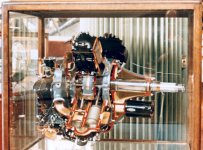
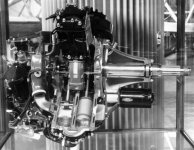
Один экземпляр, в разрезе, есть в музее Henry Ford Museum:
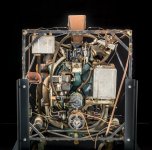
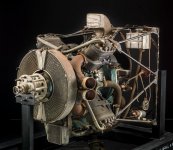
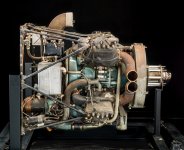
А второй, в сборе, в музее National Air and Space Museum:
 airandspace.si.edu

И немножко истории:
Один экземпляр, в разрезе, есть в музее Henry Ford Museum:
А второй, в сборе, в музее National Air and Space Museum:
General Motors X-250, Radial 4 (8) Engine | National Air and Space Museum
И немножко истории:
[td]Shortly after the General Motors Corporation (GM) purchased the Allison Engineering Company on 1 Apr 1929, the General Motors Research Laboratories (GMRL) began work on a series of 2-stroke U-cylinder engines that featured dual cylinders joined by a common combustion chamber. The two pistons were connected to the crankshaft in a way that produced different port timings for the intake and exhaust pistons. This was typically done by phasing the crankpins at small angles (10° ~ 20°). If the proliferation of patents covering this U-cylinder scheme is any clue, this was a popular concept in the 1920s and early 1930s. GMRL continued to work with this concept through the 1930s and into the mid-1940s, eventually creating a 200 hp radial with four cylinder pairs called the X-250.
A direct-drive, liquid-cooled, supercharged, two-stroke cycle engine, this General Motors engine was a very unusual design incorporating four cylinder blocks, each containing two cylinder bores with a common combustion chamber. At least one application was a small radio controlled target aircraft, and it also powered an Oldsmobile Eight automobile. Flight testing by famed racing and test pilot Tony LeVier successfully continued through 1940 as high as 7.6 km (25,000 ft.) in a Cessna Airmaster C-165, but other pressing war priorities led to termination of the project.
A 1942 engineering report written by GM's Research Laboratories, led at the time by its highly regarded director Charles F. Kettering, stated that the engine had excellent power/displacement and power/weight ratios, low fuel consumption, and very low vibration characteristics.
Removed from the Cessna in June 1946, the aircraft was later refurbished and flown again.
[/td]


